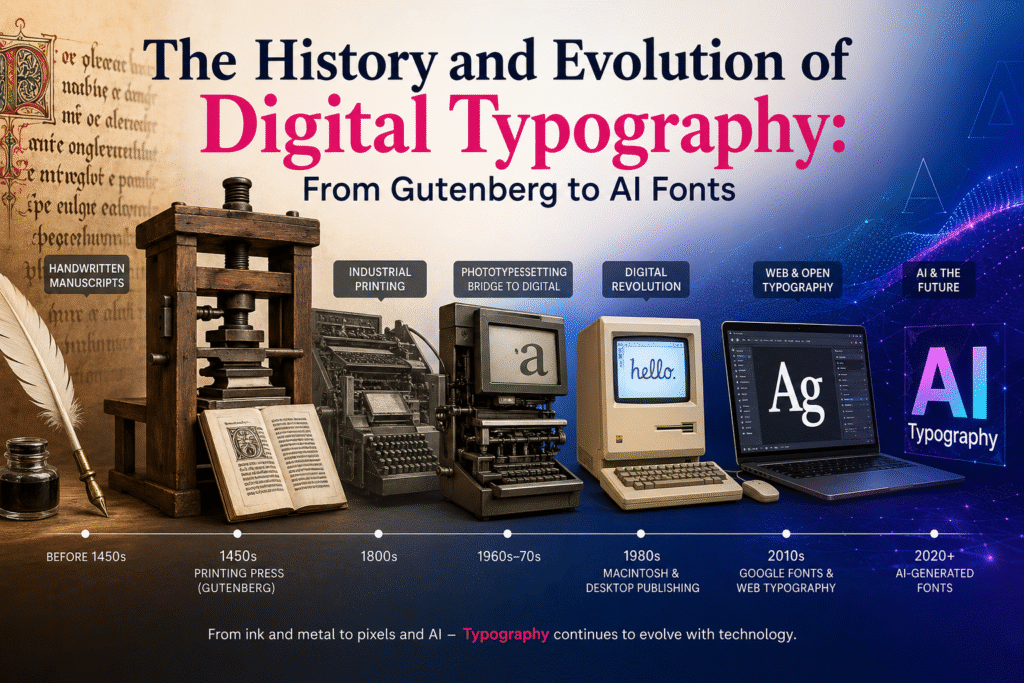
The History and Evolution of Digital Typography: From Gutenberg to AI Fonts
TL;DR
- Digital typography didn’t start with modern design software—it evolved over centuries.
- Typography began with handwritten manuscripts before mechanical printing existed.
- Johannes Gutenberg revolutionized typography in the 1450s with the printing press.
- The Industrial Revolution scaled typography through newspapers, advertising, and mass printing.
- Phototypesetting became the bridge between traditional print and digital typography.
- Personal computers in the 1980s accelerated digital typography adoption.
- Apple Inc. Macintosh transformed desktop publishing.
- Adobe PostScript improved digital font rendering.
- Microsoft TrueType made fonts more accessible to everyday users.
- Google Fonts made web typography more accessible worldwide.
- Variable fonts improved flexibility, performance, and responsive design.
- AI-generated typography is shaping the future of design.
- Modern typography now powers websites, apps, branding, accessibility, and digital experiences.
Introduction
Typography is everywhere, yet most people rarely think about how dramatically it has evolved. Every website you visit, app you open, and advertisement you scroll past relies on typography to communicate clearly. Yet the fonts we use today didn’t appear overnight—they’re the result of centuries of technological innovation.
Many articles explain ancient typography well but rush through the digital era where the biggest transformation actually happened. If you’ve ever wondered how typography moved from metal blocks to responsive web fonts and AI-generated type systems, this guide breaks down the full journey in a way that actually connects history to modern design.
Key Takeaways
- Typography began with handwritten manuscripts before mechanical printing.
- Johannes Gutenberg’s printing press revolutionized mass communication.
- Phototypesetting helped bridge print and digital typography.
- Apple’s Macintosh and Adobe PostScript transformed desktop publishing.
- Google Fonts made typography more accessible online.
- AI is shaping the future of typography.
What Is Digital Typography?
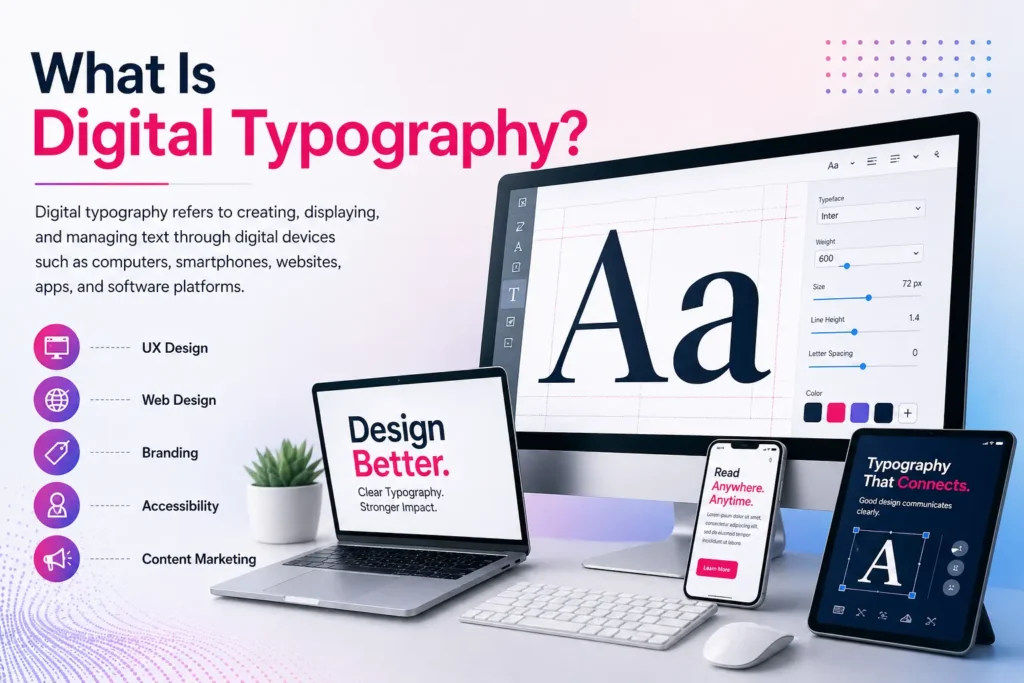
Digital typography refers to creating, displaying, and managing text through digital devices such as:
- computers
- smartphones
- websites
- software platforms
- digital advertising
- apps
Unlike traditional typography, which relied on physical printing materials, digital typography uses software and coding systems to render fonts on screens.
Today, digital typography influences:
- UX design
- web design
- branding
- accessibility
- app design
- content marketing
Typography Before Computers
Before digital tools existed, typography was entirely manual.
Scribes spent years hand-copying books using decorative lettering styles. These manuscripts were beautiful but extremely slow to produce.
Problems included:
- high production costs
- slow duplication
- inconsistent lettering
- limited accessibility
That changed dramatically in the 15th century.
| Traditional Typography | Digital Typography |
|---|---|
| Manual printing methods | Software-based creation |
| Slow revisions | Instant edits |
| Physical distribution | Global online distribution |
| Higher production costs | Lower publishing costs |
The Gutenberg Revolution (1450s)
Johannes Gutenberg introduced movable type printing in the 1450s.
This allowed printers to:
- reuse characters
- print faster
- reduce costs
- distribute books widely
The Gutenberg Bible became one of history’s biggest publishing milestones.
Impact on typography:
- standardized letterforms
- increased literacy
- expanded publishing industries
- laid the foundation for modern fonts
Without Gutenberg, digital typography wouldn’t exist.
Typography During the Industrial Revolution
The Industrial Revolution introduced mass printing.
This era created demand for:
- newspapers
- advertising posters
- magazines
- packaging
Typography became bolder and more experimental.
This period introduced:
- slab serif fonts
- display fonts
- larger type systems
- advertising typography
Brands started using typography as a competitive advantage.
The Rise of Phototypesetting
Before computers fully took over, phototypesetting became the bridge between traditional and digital typography.
Instead of using metal type:
- letters were projected onto film
- layouts became faster
- printing became more flexible
This shift helped prepare the world for fully digital systems.
Many competitors completely skip this era—even though it played a huge role in typography evolution.
The Computer Typography Revolution (1970s–1980s)
Digital typography began evolving in the mid-20th century through phototypesetting before accelerating rapidly in the 1970s and 1980s with personal computers.
Early computers had severe limitations:
- low screen resolution
- limited memory
- poor font rendering
This led to bitmap fonts.
Bitmap Fonts
Bitmap fonts were made from tiny pixel grids.
They worked well on early screens but looked blocky.
These fonts were common in:
- early operating systems
- arcade games
- first-generation computers
They solved technical problems but lacked visual quality.
Apple Changed Everything
In 1984, Apple Inc. launched the Macintosh.
This changed typography forever because designers could finally control:
- font selection
- layout
- spacing
- digital publishing
Apple helped popularize desktop publishing through the Macintosh alongside Adobe PostScript and Aldus PageMaker.
Adobe PostScript Revolution
Adobe introduced PostScript in 1985.
This allowed printers to render fonts accurately across devices.
It transformed:
- publishing
- graphic design
- printing workflows
This became one of the biggest turning points in modern design history.
Microsoft TrueType Competition
Microsoft launched TrueType to compete with Adobe.
This made typography more accessible for everyday computer users.
Fonts became easier to install and use.
The Internet Changed Typography Forever
Early websites had major font limitations.
Designers were restricted to web-safe fonts like:
- Arial
- Times New Roman
- Verdana
- Georgia
Creativity was limited.
Then web typography evolved rapidly.
The Rise of Google Fonts
Google made fonts free and accessible.
This helped:
- startups
- bloggers
- web designers
- small businesses
Typography became democratized.
Responsive Typography
As mobile devices grew, typography had to adapt to multiple screen sizes.
Designers now focus on:
- readability
- accessibility
- responsiveness
- user experience
OpenType and Variable Fonts
Microsoft and Adobe helped develop OpenType.
This allowed:
- better multilingual support
- advanced typography features
- stronger compatibility
Then came variable fonts.
Monotype helped push this innovation further.
Variable fonts allow one font file to behave in multiple ways:
- weight changes
- width changes
- style changes
This improves website speed and flexibility.
Microsoft and Adobe introduced OpenType in 1996 to improve cross-platform compatibility and support advanced typographic features like ligatures and multilingual fonts.
Typography in Mobile Apps and UX Design
Today typography impacts digital product design.
Apps like Figma, Adobe, and Canva make typography central to digital experiences.
Good typography improves:
- readability
- conversion rates
- accessibility
- engagement
Bad typography increases user frustration.
AI and the Future of Typography
AI is creating another major shift.
Tools now help designers:
- generate font pairings
- automate layouts
- personalize typography
- create custom fonts faster
Companies are exploring AI-powered design workflows at a rapid pace.
Future typography may become:
- more personalized
- more automated
- more responsive
- more immersive
Digital Typography Timeline
| Year | Milestone | Impact |
|---|---|---|
| 1450s | Gutenberg Printing Press | Mass printing begins |
| 1800s | Industrial Typography | Advertising expansion |
| 1960s | Phototypesetting | Transition away from metal type |
| 1984 | Macintosh Launch | Desktop publishing revolution |
| 1985 | Adobe PostScript | Improved font rendering |
| 1991 | TrueType Fonts | Better font accessibility |
| 2010 | Google Fonts | Free web typography access |
| 2020+ | AI Typography | Automation and personalization |
Unicode helped standardize global digital communication by allowing thousands of characters across multiple languages.
Why Digital Typography Matters Today
Typography now shapes how people experience digital content.
It influences:
- websites
- apps
- branding
- social media
- ecommerce stores
- digital advertising
Great typography builds trust.
Poor typography pushes users away.
Frequently Asked Questions
When did digital typography begin?
Digital typography began taking shape in the 1960s with phototypesetting and grew rapidly in the 1980s with personal computers.
What changed typography the most?
Gutenberg’s printing press and Apple’s Macintosh are two of the biggest turning points.
What is the future of digital typography?
AI-driven personalization, responsive typography, and variable fonts are shaping the future.
Why is typography important in digital design?
Typography affects readability, branding, user experience, and accessibility.
Final Thoughts
What makes digital typography fascinating is that it keeps reinventing itself. It started as a tool for printing books and became one of the most powerful parts of modern digital communication. From Gutenberg’s press to AI-generated fonts, typography has always evolved alongside technology—and that evolution is far from over.
References
- Adobe Typography Resources
- Microsoft Typography Documentation
- Google Fonts Documentation
- Britannica Design Archives
- Typography history publications