The History of the Barbie Logo: From 1959 to the 2023 Movie
The Barbie logo has changed shape half a dozen times since 1959, yet it always seems to circle back to where it started. If you want to recreate any of these eras yourself, the
Barbie Font Generator
lets you generate a similar script-style logo with your own name or phrase in under a minute. Here’s how the real thing evolved.
Ruth Handler’s Vision
Barbie was created by Ruth Handler, co-founder of Mattel, after she noticed her daughter Barbara using paper dolls to act out adult roles rather than playing with baby dolls. While traveling in Europe, Handler came across a German doll called Bild Lilli, which gave her the concept she needed. Barbie made her debut at the American Toy Fair in New York in March 1959, named after Handler’s daughter, with the companion doll Ken named after her son Kenneth.
BARBIE LOGO HISTORY
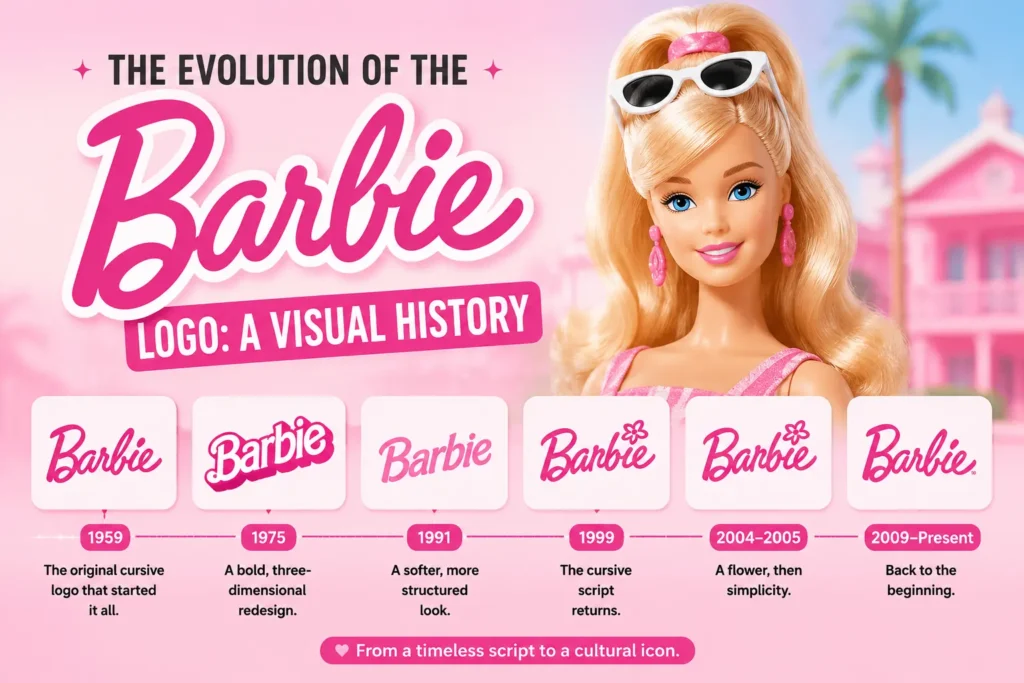
1959: The Original Cursive Logo
The first Barbie logo was a custom hand-lettered cursive wordmark in bright pink, with an enlarged capital “B” and letters that sat at slightly uneven heights, giving the design a relaxed, playful energy. This script became the foundation for nearly every version that followed, and it’s still the logo Mattel uses on packaging today.
BARBIE LOGO EVOLUTION
1975: A Bold, Three-Dimensional Redesign
The first major overhaul came in 1975. The wordmark shifted to a diagonal, slanted layout with bold white lettering set against a deep pink drop shadow, creating a three-dimensional, more attention-grabbing effect than the original. This version stuck around for over a decade and later became the visual reference point for the 2023 movie logo.
BARBIE LOGO EVOLUTION
1991: A Softer, More Structured Look
By 1991, Mattel dropped the heavy 3D shadow in favor of a flatter design with more angular, stroke-like letter terminals — a middle ground between the earlier cursive script and a more printed style. The pink also became noticeably more muted than in previous versions.
BARBIE LOGO EVOLUTION
1999: The Cursive Script Returns
Mattel brought the cursive style back in 1999, closer in spirit to the 1959 original but kept on a slanted axis, with a lighter shade of pink than the 1975 or 1991 versions.
BARBIE LOGO EVOLUTION
2004–2005: A Flower, Then Simplicity
In 2004, the dot above the “i” was briefly replaced with a small flower graphic. That detail was dropped a year later in favor of a bolder, simplified wordmark with the flower gone and a more saturated pink, reflecting a broader shift toward cleaner branding across the early 2000s.
BARBIE LOGO EVOLUTION
50th Anniversary Era
2009: Back to the Beginning
For Barbie’s 50th anniversary in 2009, Mattel retired the experimentation and returned to the original 1959 design almost unchanged, aside from a brighter, more saturated shade of pink. That decision turned out to be permanent — it’s the version still used as Barbie’s primary logo today, closely associated with the specific shade many now call “Barbie Pink.”
BARBIE MOVIE ERA
2023: The Barbie Movie Logo
For Greta Gerwig’s 2023 film starring Margot Robbie and Ryan Gosling, Warner Bros. didn’t reuse the current Mattel logo. Instead, the movie’s branding drew heavily on the bold, dimensional 1975–1991 era — leaning into nostalgia for the generation that grew up with that specific look, with extra shine added and the word “Movie” appended beneath the wordmark.
TRY IT YOURSELF
Recreate the Look Yourself
Each of these eras has its own personality, from the soft 1959 script to the bold 1975 3D treatment to the glossy 2023 movie wordmark. If you want to explore which lookalike typefaces come closest to the real thing, see our breakdown of
what font does Barbie use
.
For the cultural trend this branding helped fuel, read
what Barbiecore actually is
.
Or skip the research and build your own version directly with the
Barbie Font Generator
,
which includes script, retro, and bubble styles inspired by several of these eras.
For more on how brand typography evolves over time more broadly, see our guide to the
history and evolution of digital typography
.