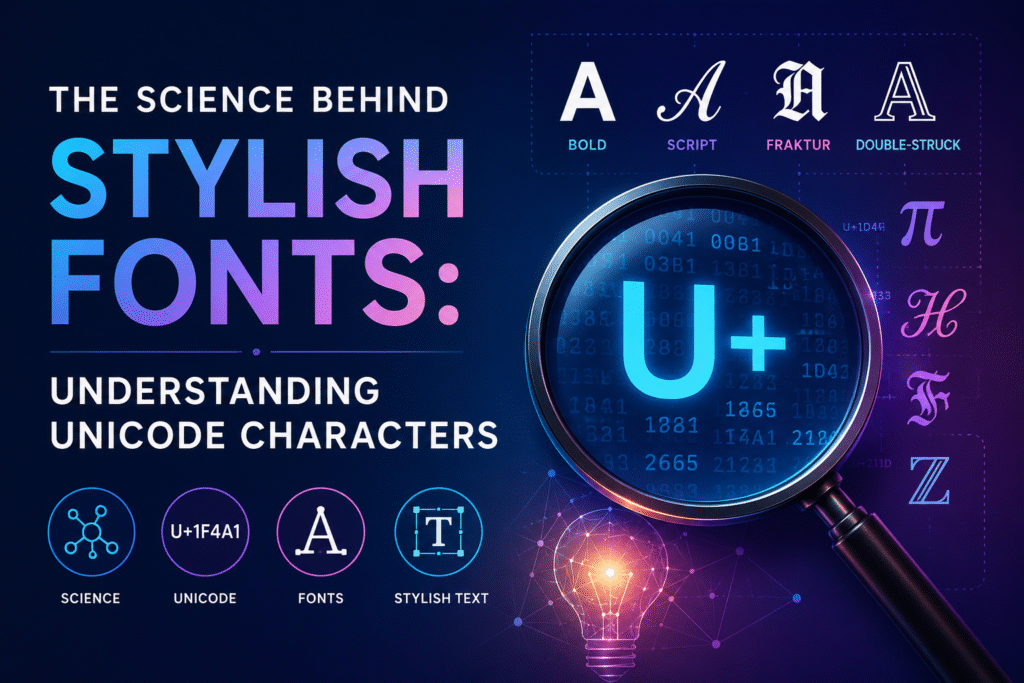
The Science Behind Stylish Fonts: Understanding Unicode Characters
Have you ever copied a stylish Instagram bio, a Gothic username, or a fancy Discord nickname and wondered how it works? At first glance, these designs look like special fonts, but the reality is much more interesting. Most stylish text you see online isn’t created by installing a new font at all. Instead, it relies on Unicode characters that already exist within the global text standard used by computers, smartphones, websites, and apps.
Understanding the science behind stylish fonts helps explain why they work on platforms like Instagram, TikTok, Facebook, and Discord without requiring users to download anything. It also reveals the technology that powers modern text styling, from mathematical symbols and Unicode code points to character mapping and rendering engines. If you’re new to the topic, our guide on Unicode fonts explained provides additional background on how Unicode-based styling works across modern devices and platforms.By 2026, Unicode supports more than 150 modern and historic writing systems, making it one of the most important standards in computing.
Key Takeaways
- Stylish fonts are usually Unicode characters, not actual font files.
- Unicode assigns a unique code point to every character and symbol.
- Font generators work by replacing normal letters with Unicode alternatives.
- Most decorative text styles come from Unicode’s Mathematical Alphanumeric Symbols block.
- Unicode styling works across many social media platforms because it remains text.
- Overusing decorative characters can create accessibility and readability issues.
What Are Stylish Fonts Really?
The term “stylish font” is slightly misleading. In most cases, stylish fonts are not actual fonts. They are alternative Unicode characters that resemble decorative versions of standard letters. Many users first encounter these characters through a fancy text generator or a social media styling tool without realizing the underlying technology behind them.If you’ve ever copied stylish text from a generator and pasted it into Instagram or Discord, you’ve already used Unicode characters without realizing it.
For example:
- Normal: ABC
- Bold Unicode: 𝐀𝐁𝐂
- Script Unicode: 𝒜𝐵𝒞
- Fraktur Unicode: 𝔄𝔅ℭ
- Double-Struck Unicode: 𝔸𝔹ℂ
These characters belong to specific Unicode blocks and can be copied and pasted across many websites and apps. Unlike traditional fonts that require installation, Unicode characters work because they are recognized by the Unicode Standard itself.
The History of Unicode and Why It Was Created
Before Unicode existed, computers struggled to display text consistently across languages and systems. Different regions used different encoding standards, making it difficult to exchange information globally. To better understand how digital text evolved to solve these challenges, it’s helpful to explore the broader history of digital typography.
Early systems relied heavily on ASCII, which supported only a limited set of English characters. As computing expanded worldwide, developers needed a universal system capable of representing thousands of languages, symbols, and scripts.
The Unicode Standard was created to solve this problem. Today, it assigns a unique code point to every supported character, allowing devices and applications to interpret text consistently.
Today, the Unicode Standard is maintained by the Unicode Consortium, a nonprofit organization that works with major technology companies, software vendors, and language experts. The consortium regularly updates the standard to support new scripts, symbols, emojis, and accessibility requirements, helping ensure consistent communication across digital platforms worldwide.
Unicode now supports:
- Latin alphabets
- Arabic
- Chinese
- Japanese
- Korean
- Mathematical symbols
- Currency symbols
- Emojis
- Technical notation
Without Unicode, modern multilingual communication and stylish text generators would not function the way they do today.
How Unicode Characters Work
Unicode works by assigning every character a unique identifier called a code point. If you’ve ever wondered how Unicode differs from encoding systems, our guide on ASCII vs Unicode vs UTF-8 explains the relationship in greater detail.
Instead of storing letters visually, computers store numerical values that represent characters.
For example:
| Character | Unicode Code Point |
| A | U+0041 |
| B | U+0042 |
| 😀 | U+1F600 |
| 𝐀 | U+1D400 |
When software encounters a code point, it retrieves the appropriate glyph from a font and displays it on the screen.
This process happens billions of times every day across websites, apps, messaging platforms, and operating systems.
Character
↓
Unicode Code Point
↓
Encoding (UTF-8)
↓
Font Glyph
↓
Rendered Text
What Is a Unicode Code Point?
A code point is the numerical identity of a character within the Unicode Standard.
Think of it as a permanent address assigned to every supported symbol.
For example:
- A = U+0041
- a = U+0061
- € = U+20AC
- 𝐀 = U+1D400
Characters vs Glyphs vs Fonts
Many people confuse characters, glyphs, and fonts. In fact, this confusion is one reason users often misunderstand Unicode styling. Our article about fonts, typefaces, and Unicode styles explores these distinctions in much more depth.
A character is an abstract unit of text. A code point identifies that character. A glyph is the visual representation displayed on screen. A font contains the glyph designs used to render characters.
For example:
- Character: A
- Code Point: U+0041
- Glyph: Visual shape of A
- Font: Arial, Times New Roman, Roboto, etc.
Understanding this distinction is essential because stylish Unicode text changes characters, not fonts.
Why Stylish Fonts Capture Human Attention
Humans naturally notice visual differences.
Psychologists refer to this as pattern interruption. When most text appears in a standard format, unusual letterforms attract attention because they break visual expectations.
Stylish text can:
- Increase visual hierarchy
- Improve perceived uniqueness
- Strengthen personal branding
- Create stronger first impressions
- Encourage engagement on social platforms
This is one reason why stylish usernames and profile bios remain popular across social media. Whether someone is customizing a gaming profile, a Discord server nickname, or an Instagram bio, decorative text often helps create a more memorable digital identity.
The Science Behind Stylish Fonts
Stylish text relies heavily on Unicode’s Mathematical Alphanumeric Symbols block. These symbols are the foundation behind many styles generated by modern text converters and social media typography tools.
These characters were originally created for mathematical notation rather than social media branding.
Mathematicians needed distinct character styles for:
- Variables
- Vectors
- Functions
- Sets
- Mathematical expressions
Unicode introduced specialized versions of letters, including:
- Bold
- Italic
- Script
- Fraktur
- Double-Struck
- Sans Serif
- Monospace
Creative users later discovered they could repurpose these symbols to create decorative text.
Why Bold, Script, Fraktur, and Double-Struck Letters Exist
These character styles were never designed as social media fonts.
Their original purpose was academic and mathematical communication.
Examples include:
- 𝐀 Mathematical Bold
- 𝒜 Mathematical Script
- 𝔄 Fraktur
- 𝔸 Double-Struck
Today, they are widely used for usernames, bios, and online branding. If you’re particularly interested in Gothic and Fraktur styles, our guide on Unicode Gothic fonts explain how these distinctive letterforms evolved and why they remain popular online.
Unicode Style Categories Explained
Unicode contains several character groups that people commonly use to create decorative text. While many users refer to them as fonts, they are actually alternative character sets contained within the Unicode Standard.
Understanding these categories helps explain why some styles appear more often in stylish usernames, social media bios, and online branding.
Mathematical Bold Characters
Mathematical Bold characters are among the most commonly used Unicode styles because they closely resemble traditional bold formatting while remaining fully copy-and-paste compatible.
Example:
- Normal: Hello
- Bold: 𝐇𝐞𝐥𝐥𝐨
These symbols were originally designed for mathematical notation rather than decorative text. However, modern users frequently employ them in social media profiles, comments, and gaming usernames because they stand out visually.
Script and Cursive Unicode Characters
Script characters mimic handwriting and calligraphy. Their flowing appearance makes them popular for aesthetic content, branding, and personal profiles.
Example:
- Normal: Welcome
- Script: 𝒲𝑒𝓁𝒸𝑜𝓂𝑒
Many users discover these styles through a cursive font generator when looking for elegant text designs for Instagram bios, invitations, or creative projects.
Some script characters may display differently across platforms because support varies between operating systems and applications.
Fraktur and Gothic Unicode Characters
Fraktur characters are inspired by traditional blackletter writing styles that were widely used in Europe for centuries.
Example:
- Normal: Gothic
- Fraktur: 𝔊𝔬𝔱𝔥𝔦𝔠
Today, Fraktur remains one of the most recognizable decorative Unicode styles. Users often choose it for gaming profiles, artistic branding, and social media aesthetics.
Many people also use a gothic font generator to quickly convert ordinary text into Gothic-style Unicode characters.
Double-Struck and Monospace Unicode Characters
Double-Struck characters were originally created for mathematical notation, particularly when representing specific number systems and mathematical concepts.
Examples:
- 𝔻𝕠𝕦𝕓𝕝𝕖-𝕊𝕥𝕣𝕦𝕔𝕜
- 𝕋𝕖𝕩𝕥
Monospace Unicode characters, meanwhile, mimic fixed-width typewriter text.
Examples:
- 𝙼𝚘𝚗𝚘𝚜𝚙𝚊𝚌𝚎
- 𝚂𝚝𝚢𝚕𝚎
Although less common than Script or Fraktur styles, both categories remain popular among users seeking unique text appearances.
How Stylish Font Generators Actually Work
Many people assume a font generator creates new fonts. In reality, most generators simply perform character substitution using predefined Unicode mapping tables.
Whether you’re using a fancy text generator or learning how online font generators function, the underlying process remains largely the same.
For example:
Input:
Hello
Output:
𝐇𝐞𝐥𝐥𝐨
The software takes each standard character and replaces it with a visually similar Unicode alternative.
No font installation occurs.
No graphic rendering occurs.
No image generation occurs.
The result remains plain text that can be copied, pasted, searched, and displayed across compatible platforms.
Character Mapping Explained
Character mapping is the process of matching standard characters with stylistic Unicode alternatives.
Example:
| Standard | Unicode Replacement |
| A | 𝐀 |
| B | 𝐁 |
| C | 𝐂 |
| D | 𝐃 |
When a user enters text, the software references a mapping table and substitutes each character with its corresponding Unicode equivalent.
This process happens instantly and requires very little computing power.
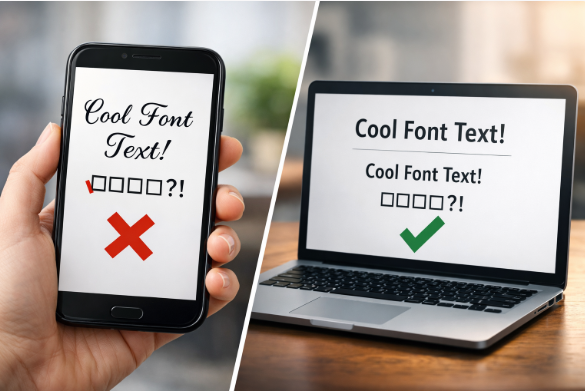
Character mapping also helps explain why some fancy fonts don’t work on certain apps or devices. If a platform lacks support for certain Unicode blocks, the substituted characters may fail to render correctly.
Unicode vs Real Fonts: Understanding the Difference
One of the biggest misconceptions surrounding stylish text is the belief that Unicode styles and traditional fonts are the same thing.
They are not.
A traditional font is a collection of glyph designs stored inside a font file. Unicode, on the other hand, defines characters and code points.
If you’re still unsure about the distinction, our guide covering fonts, typefaces, and Unicode styles explores the topic in much greater detail.
The difference can be summarized below:
| Feature | Unicode Styling | Traditional Fonts |
| Works Across Apps | Yes | No |
| Requires Installation | No | Yes |
| Copy/Paste Friendly | Yes | No |
| Platform Independent | Often | Limited |
| Uses Character Substitution | Yes | No |
Traditional fonts change how characters are visually rendered.
Unicode styling changes the characters themselves.
This distinction is what allows stylish Unicode text to travel across platforms without requiring users to install additional font files.
Many decorative styles that resemble handwriting are often confused with real font files, particularly when generated through tools such as a calligraphy font generator.
Why Unicode Stylish Fonts Work on Instagram, TikTok, Facebook, and Discord
Unicode is supported by virtually every major social media platform because it enables global communication across different languages and writing systems.
As a result, Unicode-based stylish text often works wherever Unicode itself is supported.
This is why users can create customized usernames, bios, and posts using decorative characters without installing anything on their devices.
Popular examples include:
- Instagram bios
- TikTok usernames
- Facebook posts
- Discord nicknames
- Gaming profiles
- YouTube channel branding
| Platform | Common Unicode Font Use |
| Bios and display names | |
| TikTok | Usernames and captions |
| Decorative posts | |
| Discord | Server nicknames |
| Stylish messages | |
| Gaming Platforms | Unique gamer tags |
Many creators use an Instagram font generator to customize their profile appearance and experiment with different text styles.
Similarly, users looking for profile inspiration often browse collections of the best stylish fonts for Instagram bios before selecting a design that matches their personal brand.
Beyond Instagram, Unicode styling is widely used on messaging platforms. For example, many users employ creative formatting techniques described in WhatsApp stylish text tricks to make messages stand out.
Gaming communities also rely heavily on decorative text. A Discord font generator can help users create distinctive server nicknames, while a Facebook font generator is often used to customize posts and profile content.
The growing popularity of decorative Unicode text demonstrates how flexible the Unicode Standard has become far beyond its original purpose.
FAQS
Can Unicode Fonts Be Copied and Pasted?
Yes. Because Unicode styles remain text rather than images, they can usually be copied, pasted, and shared across compatible platforms.
Are Unicode Fonts Supported on iPhone and Android?
Most modern iPhone and Android devices support a large portion of the Unicode Standard. However, support for specific character blocks may vary depending on the operating system version and installed fonts.
What’s the Difference Between Unicode and a Font File?
Unicode defines characters and code points, while a font file contains the visual glyphs used to display those characters. Unicode determines what a character is, while a font determines how it looks.