What Is a Gothic Font? History, Types, and Modern Uses of Gothic Typography
Gothic fonts are everywhere today, from tattoo lettering and metal band logos to luxury branding and gaming graphics. But many people still confuse Gothic typography with Old English fonts, Blackletter scripts, or even modern sans-serif typefaces labeled as “Gothic.” That confusion is understandable because the term has evolved over centuries and now means different things depending on the typography context.
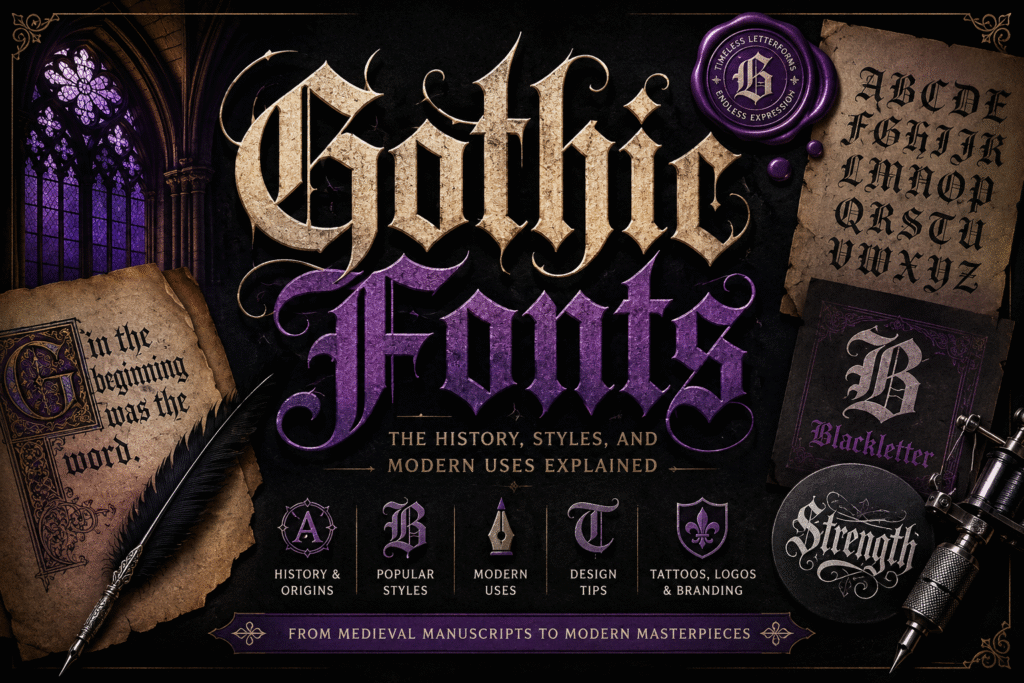
At its core, a Gothic font refers to an expressive lettering style inspired by medieval European writing. These fonts are known for their sharp strokes, decorative details, and dense letterforms that create a bold visual identity. While Gothic typography began in handwritten manuscripts during the Middle Ages, modern designers now use it in branding, digital art, tattoos, apparel, and stylized online text.
What Is a Gothic Font?
A Gothic font is a typography style based on medieval European script traditions, especially Blackletter writing. These fonts typically feature:
- Sharp angular strokes
- Decorative details
- Tall vertical letterforms
- Dense spacing
- Dramatic visual contrast
Historically, Gothic lettering was used in handwritten manuscripts before the printing press became widespread. Over time, printers adapted the style into movable type, helping Gothic typography spread throughout Europe.
Today, the term “Gothic font” can mean different things depending on the context:
- Traditional Blackletter typography
- Old English-style decorative fonts
- Gothic calligraphy
- Modern display fonts
- In some American typography systems, even sans-serif fonts
If you want to better understand typography terminology, our guide on difference between fonts and typefaces explains how these terms are often misunderstood online.
✦ The History of Gothic Typography ✦
Gothic typography originated in medieval Europe during the 12th century. Scribes developed this writing style to save space on expensive parchment while keeping manuscripts visually striking and highly structured. During the 19th-century Gothic Revival movement, medieval-inspired typography and architecture became fashionable again in Europe and America.
The result was a compact script style with narrow letters and intense vertical emphasis. Over time, this style became associated with religious manuscripts, universities, and official documents.
- 12th Century: Gothic script begins appearing in medieval Europe.
- 13th–14th Century: Blackletter styles spread through religious manuscripts and universities.
- 15th Century: Gutenberg popularizes Blackletter typography through the printing press.
- 19th Century: Gothic revival aesthetics influence art and architecture.
- Modern Era: Gothic fonts become popular in branding, tattoos, fashion, and digital design.
✦ Gothic Fonts in Medieval Europe ✦
During the Middle Ages, monasteries and religious institutions relied heavily on handwritten manuscripts. Monks used broad-edge pens to create carefully structured Gothic lettering that balanced readability with decorative beauty.
These scripts eventually evolved into several distinct Blackletter styles, including:
Some heavily decorative Blackletter fonts can look impressive at first glance but become exhausting to read after a few sentences.
Many modern calligraphy lettering styles still borrow visual elements from these medieval scripts.
✦ How the Printing Press Popularized Blackletter Fonts ✦
Johannes Gutenberg played a major role in spreading Gothic typography through the invention of the printing press. His famous Gutenberg Bible used a Blackletter-inspired typeface that closely resembled handwritten manuscripts.
Gutenberg Bible
One of the earliest major printed books that helped Gothic and Blackletter typography spread across Europe.
As printing technology expanded across Europe, Gothic fonts became widely used in books, newspapers, and official printing.
If you enjoy typography history, you may also like our article on the evolution of typography , which explores how type design evolved from Gutenberg to modern AI-generated fonts.
✦ Different Types of Gothic Fonts ✦
Not all Gothic fonts look the same. Over centuries, several Blackletter variations developed across different regions of Europe.
| Gothic Font Style | Visual Characteristics | Region of Popularity | Readability | Common Modern Uses |
|---|---|---|---|---|
| Textura | Sharp, narrow, highly angular lettering | Medieval Europe | Low | Historical designs, fantasy themes |
| Fraktur | Decorative strokes with flowing details | Germany | Medium | Logos, tattoos, branding |
| Schwabacher | Rounded shapes with softer edges | Renaissance Germany | Medium-High | Vintage typography, decorative text |
| Rotunda | Wider spacing and smoother curves | Italy & Southern Europe | High | Elegant historical typography |
✦ Major Gothic Script Styles ✦
Textura
Textura is one of the oldest and most recognizable Gothic script styles. It uses:
- Narrow letter spacing
- Sharp angular forms
- Dense vertical patterns
- Strong geometric consistency
This is the classic medieval style many people imagine when thinking about Gothic manuscripts.
Fraktur
Fraktur became especially popular in Germany and later evolved into one of the most famous Blackletter styles.
Compared to Textura, Fraktur often appears:
- More decorative
- Slightly more readable
- More artistic and flowing
Many modern Blackletter-inspired logos still borrow visual traits from Fraktur typography.
Schwabacher
Schwabacher uses softer curves and more rounded strokes compared to sharper Gothic scripts.
This style helped bridge the gap between dense medieval lettering and more readable Renaissance typography.
Rotunda
Rotunda developed primarily in Southern Europe and Italy. Unlike the rigid appearance of Textura, Rotunda features:
- Rounded letterforms
- Softer visual flow
- Wider spacing
- Improved readability
Because of its smoother appearance, Rotunda often feels less intimidating than traditional Blackletter fonts.
✦ Gothic Fonts vs Blackletter Fonts ✦
This is one of the most confusing topics in typography.
| Term | Meaning | Common Usage Today |
|---|---|---|
| Gothic Font | Broad term often used for medieval-inspired decorative typography | Branding, tattoos, logos, dramatic display text |
| Blackletter | Historical typography category used in medieval Europe | Typography history, classic Gothic scripts |
| Old English | Popular decorative style inspired by Blackletter lettering | Tattoos, certificates, vintage designs |
In most modern discussions, Gothic fonts and Blackletter fonts are often treated as the same thing. Historically, “Gothic” became a broad label used to describe Blackletter writing styles throughout Europe.
However, some people also associate Gothic fonts with:
- Old English lettering
- Dark fantasy typography
- Decorative horror-style fonts
- Victorian Gothic aesthetics
Technically, Blackletter is the more accurate typography term for medieval Gothic script styles.
Understanding these distinctions is important because typography terminology online is often inconsistent. Many font marketplaces, generators, and design tools categorize styles differently.
✦ Why Is Sans-Serif Sometimes Called “Gothic”? ✦
One of the strangest typography contradictions is that some American type foundries historically used the word “Gothic” to describe sans-serif typefaces.
For example, fonts like Franklin Gothic are not Blackletter fonts at all.
In American typography classification systems, “Gothic” eventually became associated with clean sans-serif designs rather than medieval scripts.
This is why searching for Gothic fonts online can sometimes produce completely different font styles depending on the platform.
✦ Common Features of Gothic Lettering ✦
Although Gothic fonts vary widely, most styles share several recognizable characteristics:
Strong vertical emphasis
Decorative flourishes
Angular or broken strokes
Dense visual texture
Dramatic contrast
Historic manuscript influence
These details give Gothic typography its powerful and recognizable appearance.
Modern creators often use these styles to communicate:
✦ Modern Uses of Gothic Fonts ✦
Although Gothic typography originated centuries ago, it remains popular in modern design.
Today, designers use Gothic fonts in:
Many creators now use a Gothic font generator to quickly create visually heavy Blackletter-inspired text for modern projects.
✦ Gothic Fonts in Branding and Logos ✦
Gothic typography works especially well for brands that want a bold or historic identity.
You’ll often see Gothic-inspired lettering in:
Because these fonts create strong visual emotion, they are usually used for headlines and logos rather than long paragraphs.Many luxury and streetwear brands use Gothic typography because it instantly feels bold and emotionally charged.
✦ Gothic Fonts in Tattoos and Art ✦
Blackletter tattoo designs remain one of the most popular uses of Gothic typography.
Tattoo artists often choose Gothic lettering because it creates:
If you want to experiment with Blackletter-inspired tattoo styles, you can try our tattoo font generator for stylized lettering ideas.
✦ Are Gothic Fonts Hard to Read? ✦
Traditional Gothic fonts can sometimes be difficult to read, especially in long paragraphs.
The dense spacing and decorative strokes that make Gothic typography visually impressive can also reduce readability.
This is why most designers use Gothic fonts for:
rather than body text.
Modern designers often improve readability by pairing Gothic fonts with clean sans-serif typography.
✦ Best Practices for Using Gothic Typography ✦
If you want Gothic fonts to look professional instead of overwhelming, a few typography principles make a big difference.
✦ Best Uses for Gothic Fonts ✦
- Logos and branding
- Tattoo lettering
- Album covers
- Gaming graphics
- Posters and merchandise
✦ Avoid Using Gothic Fonts For ✦
- Long body paragraphs
- Accessibility-focused interfaces
- Small mobile text
- Professional business documents
Keep Gothic Fonts for Display Use
Use Gothic lettering mainly for:
Avoid using Blackletter styles for long-form paragraphs.
Pair Gothic Fonts With Simple Typography
Combining bold Gothic lettering with modern sans-serif fonts helps balance readability and aesthetics.
Use Proper Spacing
Tight spacing can make Gothic typography difficult to read. Small spacing adjustments can improve visual clarity significantly.
Consider Digital Compatibility
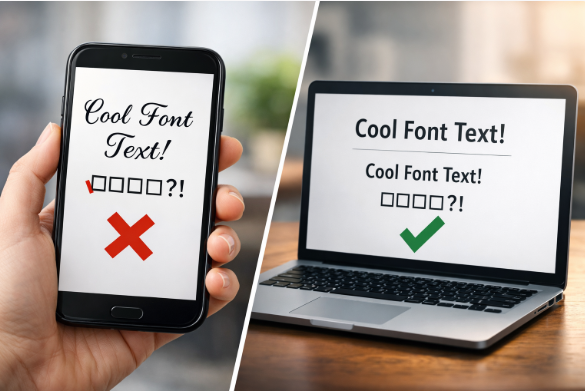
Many decorative font styles online are actually Unicode character sets rather than true installable fonts. Our guide on Unicode font styles explains how stylized online text works across different platforms and apps.
✦ Popular Gothic Font Examples ✦
Some of the most recognizable Gothic and Blackletter font styles include:
Today, creators also experiment with:
If you enjoy decorative online typography, tools like our fancy text generator and cool font generator can help you explore different stylized text aesthetics.
✦ Frequently Asked Questions About Gothic Fonts ✦
What is the difference between Gothic and Blackletter fonts?
Blackletter is the historical typography category that includes medieval Gothic script styles. Gothic fonts is a broader modern term often used for decorative Blackletter-inspired typography.
Are Gothic fonts hard to read?
Some traditional Gothic fonts can be difficult to read because of their dense spacing and decorative strokes. Designers usually use them for headings, logos, and short text instead of long paragraphs.
Why are some sans-serif fonts called Gothic?
In American typography systems, the word “Gothic” was historically used to describe sans-serif typefaces. This differs from the medieval Blackletter meaning commonly associated with Gothic typography today.
Are Gothic fonts the same as Old English fonts?
Most ‘Old English fonts’ are modern decorative interpretations inspired by historical Blackletter scripts. While closely related, Old English is more of a modern stylistic label than a formal typography classification.
What are Gothic fonts used for today?
Modern Gothic fonts are commonly used in logos, tattoos, gaming graphics, music artwork, luxury branding, and decorative digital typography.
✦ Related Typography Guides ✦
✦ Final Thoughts on Gothic Typography ✦
Gothic fonts have survived for centuries because they create a visual style that feels intense, historic, and emotionally powerful all at once.
From medieval manuscripts to modern branding and tattoo culture, Gothic typography continues to evolve while keeping its unmistakable identity.
Whether you’re studying typography history, building a bold brand aesthetic, or experimenting with decorative lettering online, understanding Gothic fonts helps you appreciate how deeply typography shapes visual culture.